
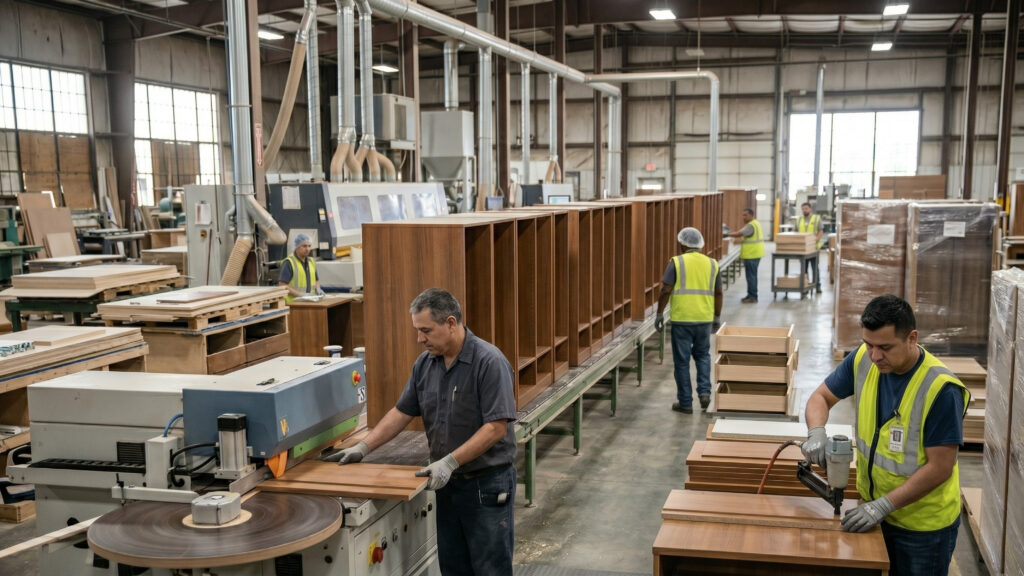
When a project demands 500 identical wardrobes, 300 office workstations, or an entire building’s worth of fitted doors — most manufacturers quietly step back. We step forward.
There’s a specific kind of pressure that comes with large institutional furniture projects. It’s not just about craftsmanship. It’s about delivering the same quality on unit number 400 as you did on unit number one. It’s about meeting deadlines when the civil contractor is waiting, the interior team is ready, and the client’s handover date is non-negotiable. It’s about making sure every single piece — across every single floor — looks, feels, and functions identically.
This is not a game for small players. And frankly, it’s not a game most manufacturers are equipped to play.
Let’s talk about what real manufacturing strength actually looks like in large institutional furniture projects — and why it matters more than almost any other factor when you’re making a high-stakes procurement decision.
The Illusion of Scale — And Why It Fails
Walk into any mid-size furniture workshop and you’ll likely see skilled craftsmen doing impressive work. Custom joints, hand-finished surfaces, bespoke details — genuinely beautiful output. But ask them to produce 200 identical units of that piece, delivered in phases over six months, and the cracks begin to show almost immediately.
Why?
Because there’s a fundamental difference between crafting furniture and manufacturing it at institutional scale. Craft is an art. Manufacturing at scale is a system. And most workshops — regardless of how talented their team is — are built around art, not systems.
When volume enters the equation, unstructured workshops face a cascade of problems: inconsistent finishes because different workers apply different techniques, material procurement delays because bulk sourcing wasn’t planned, missed delivery windows because production timelines were estimated rather than engineered. Each one of these issues creates downstream problems for the project — cost overruns, delays, disputes, and in many cases, the uncomfortable task of explaining to senior stakeholders why the furniture doesn’t match.
This is the illusion of scale: the assumption that a capable small manufacturer can simply “do more” of what they do. In institutional furniture, that assumption is costly.
What Manufacturing Strength Actually Means
Real manufacturing strength in the context of institutional and large commercial furniture is built on four non-negotiable pillars.
1. Prototype-First, Scale-Second
Every large institutional project we take on begins the same way — with a single, perfected prototype. Before a single production unit is made, the design is locked. Materials are specified. Dimensions are verified. Finishes are approved. This prototype becomes the physical benchmark against which every subsequent unit is measured.
This approach eliminates ambiguity. There is no “close enough” in institutional furniture — especially when you’re furnishing a building that will be occupied by hundreds of people and inspected by multiple quality teams. The prototype is the contract. Everything produced after it must match it, or it doesn’t leave the floor.
2. Workforce Training at the Start, Not Along the Way
One of the biggest hidden costs in large furniture projects is mid-project retraining. When production begins before the team is fully aligned, you get variation — and variation in bulk production is expensive to correct.
Our model flips this. Before we begin production, our workforce is comprehensively trained on the specific project. Every carpenter, every finisher, every quality checker understands exactly what’s being made, how it’s being made, and what “acceptable” looks like. Once the team is trained and production begins, it doesn’t stop. The system runs.
This is what allows us to maintain consistency across hundreds or thousands of units — not magic, but disciplined preparation.
3. Standardized Production Processes That Don’t Bend
In institutional furniture manufacturing, improvisation is the enemy. Every decision that can be standardized, must be. Cutting dimensions, material grades, joinery methods, surface treatments, hardware specifications — all of it is documented, standardized, and enforced.
This level of process discipline might sound inflexible, but it’s actually what creates the flexibility to scale. When every step is defined, production can be expanded, accelerated, or adjusted without introducing inconsistency. New workers can be onboarded quickly. Quality checks can be conducted efficiently. Deliveries can be planned with accuracy.
Standardization is not a constraint. It’s the engine of scale.
4. Material Sourcing Built for Volume
Institutional projects have no room for material supply disruptions mid-production. Sourcing at scale requires relationships with suppliers who can sustain consistent quality and volume across the project’s entire lifecycle. It requires forward planning — ordering materials before they’re needed, not when they’re needed.
Our manufacturing model is built around bulk procurement. We work with trusted material partners who understand the demands of large-volume production. This means the wood quality on unit 1 is the same as on unit 500. The hardware doesn’t change. The finish doesn’t shift. Consistency in material sourcing is what makes consistency in output possible.
The Real Cost of Getting This Wrong
Decision-makers in institutional projects — procurement teams, quality inspectors, project heads — often evaluate furniture vendors primarily on price. It’s understandable. When you’re outfitting an entire building, cost matters. But experienced procurement professionals know that the cheapest bid rarely delivers the lowest total cost.
Consider the downstream consequences of choosing a manufacturer who isn’t genuinely equipped for scale:
- Rework and replacement costs when units don’t meet quality standards
- Project delays that push back handover timelines and trigger penalty clauses
- Reputation risk for the decision-makers who approved the vendor
- Logistical chaos when deliveries arrive inconsistently or incomplete
- Post-installation complaints from occupants or clients who notice quality variation
None of these costs appear on the initial quote. They emerge later — and they can be significant.
Manufacturing strength isn’t just a quality argument. It’s a financial argument. A risk management argument. Choosing a partner who is genuinely built for institutional scale protects the project, the budget, and the decision-makers who signed off on it.
Why Institutional Projects Demand a Different Kind of Partner
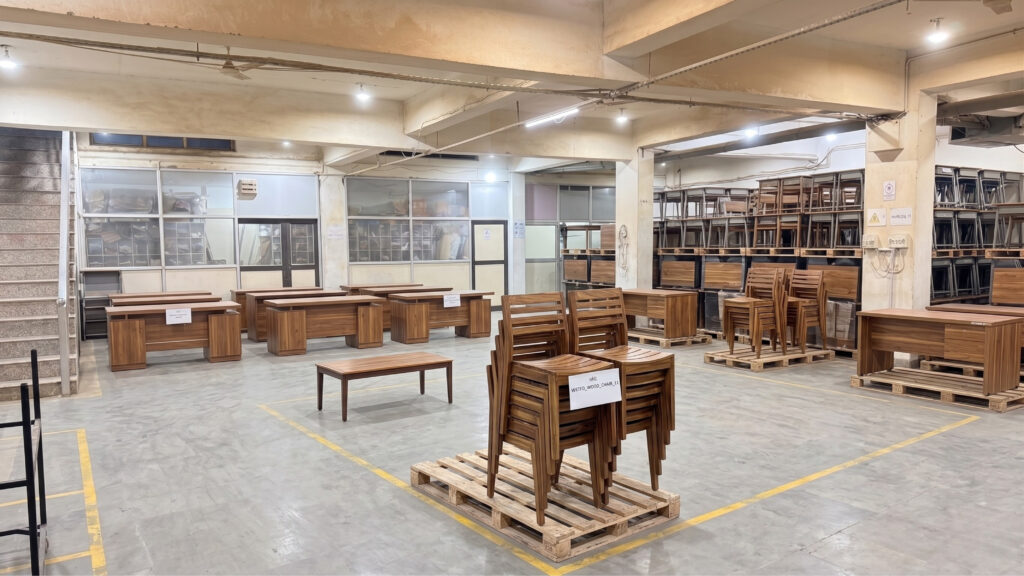
Large institutional furniture projects — whether for residential complexes, corporate headquarters, hospitality properties, educational institutions, or healthcare facilities — share a common set of demands that simply don’t exist in smaller projects.
They require a partner who can sustain quality over long production runs, not just deliver an impressive sample.
They require a partner whose processes are documented and repeatable, not dependent on the mood or memory of individual craftsmen.
They require a partner who communicates proactively about timelines, materials, and production status — because at institutional scale, surprises are problems.
They require a partner who has done this before. Not once, but consistently. Across different project types, different material specifications, different delivery requirements.
This is the standard we hold ourselves to — and the standard every institutional procurement team should hold their manufacturing partners to.
The Decision-Maker’s Lens
Here’s something worth understanding about how institutional furniture decisions actually get made.
In most large projects, the decision doesn’t sit with a single person. The CEO or MD initiates the requirement. The accounts team evaluates cost structure. The quality team assesses manufacturing capability and material standards. The procurement team investigates track record and delivery reliability. Each team evaluates independently — and often, each team surfaces different vendor options.
What this means in practice is that a manufacturer’s credibility has to hold up under multiple, independent forms of scrutiny. It’s not enough to impress the quality inspector if the procurement team can’t verify your delivery record. It’s not enough to offer the right price if the quality team can’t confirm your manufacturing standards.
This is why we focus not just on manufacturing excellence, but on the full picture of what institutional decision-makers actually evaluate: process transparency, proven track record, scalability evidence, and consistent quality across every touchpoint.
When multiple departments independently arrive at the same recommendation, selection becomes almost inevitable. Building that kind of cross-functional credibility is not an accident — it’s a strategy.
Scale Without Compromise — What It Looks Like in Practice
We currently manufacture for institutional clients whose projects demand precision, consistency, and volume. Whether it’s fitted furniture for large residential developments or bespoke wooden solutions for commercial interiors, our manufacturing model is designed specifically for projects where “almost right” isn’t an option.
Our approach to every project:
- Define the prototype with full stakeholder alignment before production begins
- Lock materials, specifications, and processes before the first production unit is made
- Train our workforce comprehensively on the specific project requirements
- Run production as a disciplined, standardized system — not a workshop
- Maintain active quality checks throughout production, not just at delivery
- Communicate proactively at every stage so project managers are never in the dark
This isn’t a pitch. It’s a description of what large institutional furniture manufacturing actually requires — and what we’ve built our entire operation around.
Final Thought: Strength Is Built, Not Claimed
Every manufacturer will tell you they deliver quality. Every workshop will promise consistency. Every vendor will say they can handle your project.
The question worth asking — the one that separates real manufacturing partners from aspirational ones — is simple: Show me how.
Show me your prototype process. Show me how you train your workforce. Show me your quality documentation. Show me a project at scale that you’ve completed, and tell me what happened when something went wrong. Show me how your supply chain holds up when demand spikes.
Manufacturing strength behind large institutional furniture projects is not a claim. It’s a system, a process, a culture, and a track record. It’s built over time through discipline, investment, and a deliberate choice to serve a specific kind of client — one who demands more, because their projects require it.
That’s who we are. And that’s the only kind of project we take on.
Looking to partner with a manufacturer who’s built for institutional scale? Let’s talk about your project.