
Two qualities. One non-negotiable standard. And the reason most large furniture projects quietly fall apart before they’re even finished.
Here’s a scenario that plays out more often than anyone in the industry likes to admit.
A developer is furnishing 150 apartments in a newly completed residential tower. A hotel group is equipping 200 rooms across a new property. A mall developer is fitting out retail units across four floors. A corporate group is setting up offices across an entire commercial complex.
Each of them goes through the same process — they shortlist manufacturers, request samples, review quotes, and make a decision. The samples look impressive. The finish is clean, the dimensions are accurate, the quality feels right. Production begins.
Then, six weeks later, the first delivery arrives on site.
And it’s almost right.
The color is slightly off from the approved sample. A few units have edges that aren’t as sharp. The hardware alignment is a millimeter out on some pieces. Individually, none of it seems catastrophic. But multiply that across 200 rooms, 150 apartments, or 4 floors of a commercial building — and you have a problem that no amount of goodwill can quietly fix.
This is what happens when precision and consistency are treated as separate qualities — or worse, when one is mistaken for the other.
They are not the same thing. And in large-scale furniture manufacturing — across any sector, any project type — you need both, working together, without exception.
Precision and Consistency — Not Synonyms, Not Optional
Let’s define these clearly, because the distinction matters enormously when you’re evaluating a manufacturing partner for a large project.
Precision is accuracy. It’s the ability to produce a piece of furniture that matches the specification — exactly. The right dimensions, the right material grade, the right finish, the right joinery. Precision is about getting it right.
Consistency is repeatability. It’s the ability to produce that same piece — to the same standard — across every unit, across the entire production run. Consistency is about staying right.
A manufacturer can be precise without being consistent. They can produce a perfect prototype and struggle to replicate it at volume. This is actually the most common failure mode in large furniture projects — not an inability to do good work, but an inability to sustain it.
A manufacturer cannot, however, be truly consistent without first being precise. If the baseline standard isn’t defined with accuracy, there’s nothing worth replicating consistently.
This is why the most important question to ask any furniture manufacturer before committing to a large project isn’t “Can you show me your best work?” It’s — “Show me unit number 200. And then show me unit number 201.”
Why Precision Alone Breaks Down at Volume
There’s a reason the most skilled craftsmen in the world don’t always run the largest manufacturing operations. Craft and manufacturing are different disciplines. Both require skill. Both require care. But they operate on entirely different frameworks.
A craftsman applies precision personally — through their hands, their eye, their experience. The output is precise because they are precise. But that precision doesn’t transfer automatically when a team of 20 people is producing 400 units simultaneously across a factory floor.
At volume, precision has to be designed into the process, not left to individual skill. It has to live in:
- Material specifications — not “good quality wood,” but a defined grade, a defined thickness, a defined moisture content. Specifications that can be verified before material enters production, not after it comes back wrong.
- Tooling and machinery calibration — cutting, shaping, and drilling equipment that is calibrated regularly and consistently. Equipment that produces the same output on day one of production as it does on day forty.
- Joinery and assembly standards — documented methods that every member of the production team follows without exception. Not approximations. Not “close enough.” Exact, repeatable methods that hold across the entire team.
- Finishing protocols — number of coats, drying times, application methods — all standardized so that the surface finish on the last unit in a batch is indistinguishable from the first.
When precision is embedded into the system this way, it doesn’t depend on who shows up to work that morning. It doesn’t fluctuate with fatigue, distraction, or workforce turnover. It holds — because the process holds it in place.
Why Consistency Is the Hardest Thing to Fake
Consistency is where the gap between manufacturers becomes impossible to hide.
Any manufacturer can prepare for a client visit. They can clean the floor, put their best work on display, ensure the team is performing during the inspection. What they cannot fake is a completed production run of 300 units delivered across three months to a live project site. The record speaks for itself.
This is why serious buyers — whether they’re building developers, hotel procurement teams, commercial project heads, or mall developers — don’t just request samples. They request references. They ask for completed project photographs. They ask whether delivery timelines were met. They want to know about post-delivery issues and how they were resolved. They’re not evaluating the sample on the table. They’re evaluating the system behind it.
Real consistency in furniture manufacturing comes from several interconnected commitments:
- A prototype that is genuinely locked. Not “approved with adjustments to follow.” Locked. Signed off by all relevant stakeholders, documented in full, and kept as the physical reference standard on the production floor for the entire duration of the project. Any deviation — before it reaches the client — is caught and corrected.
- Quality checks built into every stage of production — not just at the end. By the time a finished unit reaches final inspection, significant time and material have already been invested in it. Catching a defect at that stage is expensive and often irreversible under deadline pressure. Consistency comes from checkpoints at material intake, during machining, during assembly, during finishing, and at final review — not just a single gate at the end of the line.
- A workforce trained on the specific project, not just on furniture making in general. There is a meaningful difference between a carpenter who is skilled and a carpenter who has been specifically trained on the exact specification they’ll be producing for the next several months. Project-specific training eliminates guesswork and sets the standard in the worker’s hands before the first unit goes into production.
- Supply chain stability across the entire production run. One of the most underestimated causes of inconsistency in large furniture projects is mid-production material variation. A batch of wood from a different supplier. Hardware from a substitute vendor because the original ran out of stock. Even when these substitutions seem minor, they introduce visible differences across units. Serious manufacturing partners lock their supply chain for the project duration — they don’t manage it reactively.
This Applies Across Every Sector — Not Just One
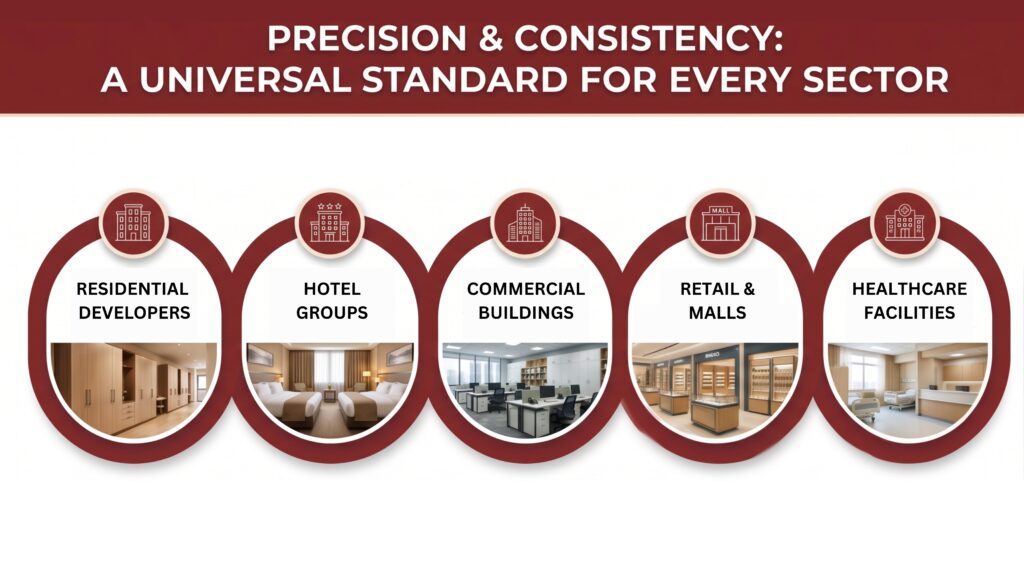
Precision and consistency are not requirements exclusive to any single type of buyer. They are universal — because the problem they solve is universal.
- A residential developer furnishing 100 apartments needs every wardrobe, every door panel, every fitted unit to match across every flat. Buyers and occupants will compare. Variations that seem small in isolation become very visible when multiplied across a building.
- A hotel group equipping 200 rooms has an even higher standard to meet. Guest experience is built on visual consistency and functional reliability. A room where the furniture doesn’t quite match the approved design — or where hardware fails within months — is a review problem, not just a procurement problem.
- A commercial building developer fitting out offices across multiple floors knows that corporate tenants have quality expectations. A floor where workstations don’t match, or where storage units have visible finish variation, reflects on the developer’s delivery standard — not just the manufacturer’s.
- A mall or retail developer fitting out shop units needs a manufacturing partner who can deliver identical units across dozens of spaces on a tight handover timeline. Delays and inconsistencies in this context have direct commercial consequences.
- A hospital or healthcare facility furnishing patient rooms, nurses’ stations, and common areas needs furniture that is precisely manufactured for specific functional requirements — and consistent enough that facility management can replace or add units later without visible mismatch.
In every one of these scenarios, the client’s requirements are different. The project scale varies. The design language changes. But the underlying demand is identical: get it right, and keep it right, across every single unit.
What to Ask Before You Commit to a Manufacturer
If you’re evaluating furniture manufacturers for a large project — regardless of what sector you’re in — these are the questions that reveal whether a manufacturer truly operates at the precision and consistency standard your project requires:
“Walk me through your prototype documentation process.”
A manufacturer who builds precision into their system has this documented and can show it to you. One who doesn’t will give you a vague answer about their experienced team.
“What quality checkpoints do you have during production — not just at final inspection?”
The answer tells you immediately whether quality is actively managed throughout production or simply inspected at the end.
“How do you ensure material consistency across a long production run?”
Supply chain stability doesn’t happen automatically. A serious manufacturing partner has planned for this before you asked.
“Can you share references from completed large-scale projects — with photos?”
The most reliable indicator of future consistency is a documented record of past consistency. References and completed project evidence matter far more than samples.
“What happens when a unit doesn’t meet your standard during production?”
How a manufacturer handles in-process failures tells you more about their quality culture than how they describe their best work.
These questions don’t require technical expertise to ask. They require the understanding that at scale, quality is a system — not a personality trait or a promise.
The Standard That Doesn’t Move
We manufacture for clients across sectors — residential developments, commercial complexes, hospitality projects, retail developments, and more. The project types vary. The specifications change. The volumes differ.
What doesn’t change is the standard.
Every project we take on begins with a locked prototype and ends with units that match it — unit one through the last one in the run. That isn’t a marketing line. It’s the operating model we’ve built our entire manufacturing process around, because we understand what happens to projects — and to the people responsible for them — when that standard slips.
Precision without consistency is just a good sample. Consistency without precision is just uniformly average output.
The only acceptable outcome — in large-scale furniture manufacturing, and in our work — is both. Together. Every time.
Because when a building opens, when a hotel welcomes its first guests, when a commercial space is handed over to its tenants — the furniture doesn’t get a second chance to meet the standard.
Neither do we. And we’ve built a system to make sure we never need one.